Types of Malocclusion
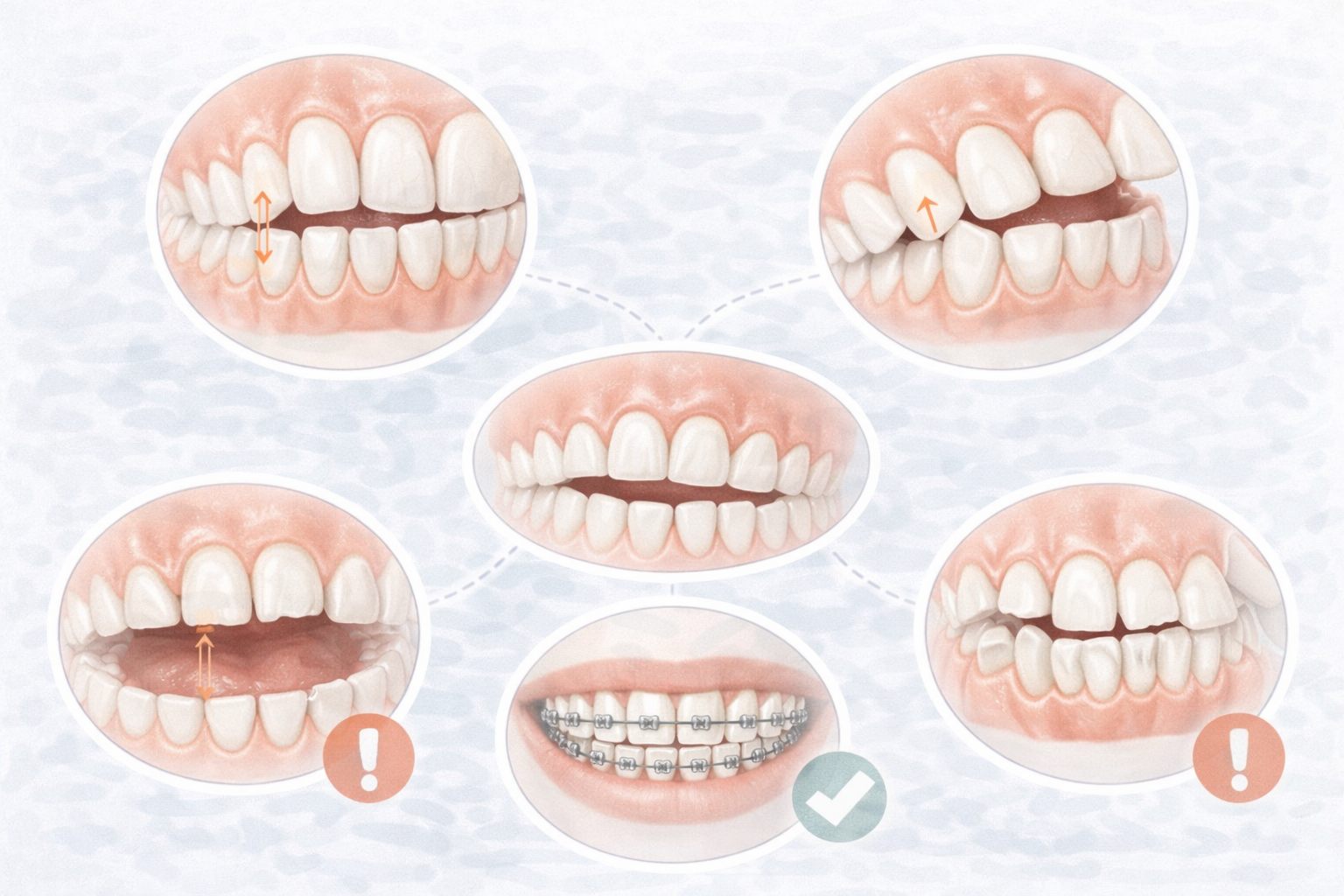
Main Types of Malocclusion
Many patients ask how to visually identify malocclusion. If the upper or lower jaw is prominent, if the teeth are crooked, or if there is visible facial asymmetry — there is likely a bite problem.
Distal Malocclusion (Prognathic)
Characterized by a jaw disproportion where the upper jaw is significantly more developed than the lower, and the upper dental arch visibly protrudes forward.
Mesial Malocclusion (Medial)
In mesial malocclusion, the lower jaw protrudes forward instead.
Crossbite
Also called scissors bite — the upper and lower teeth do not partially overlap, creating a scissors-like appearance of the dental arch.
Deep Bite
One of the most common types: upper teeth cover lower teeth by more than half. Lower incisors may traumatize soft tissue when the jaws close.
Open Bite
Dental arches cannot fully close, creating characteristic gaps.
Consequences
Malocclusion is not just an aesthetic issue. Left untreated, it can cause TMJ dysfunction, headaches, facial asymmetry, and mucosal trauma. At Orto Clinic Chisinau we provide complete diagnostics and a personalized treatment plan.